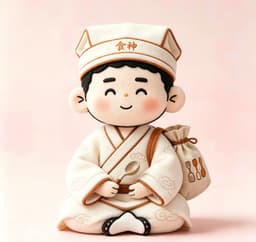
Shishen
“You carry everyone's burdens — but who carries yours?”
There is a warmth in you that people feel before they can name it. You have a gift for making things good — food that comforts, words that soothe, spaces that feel like home.
- A talent for turning the ordinary into something beautiful
- An ease that makes others feel safe enough to soften
- Quiet, steady creativity that compounds over time
- You give until you're empty, then wonder why no one noticed
- You downplay your own gifts — 'it's just cooking, just writing'
- Comfort can lull you into staying where it's easy
You love by caring — meals, small rituals, quiet acts of presence. But you often love others the way you wish to be loved, and forget to receive. The right person won't just enjoy your warmth; they'll notice when you're running cold.
You're made for work with a soul — food, design, teaching, healing, anything that makes life more livable. You don't need to be the loudest; you need room to do it slowly and do it well.
Stories that sound like you.
The first two months with someone new are the most alive you ever feel. You notice everything — the way they laugh, the pause before they answer, the way they push their hair back. You remember what they ordered on the first date. You plan things. You show up early. In those weeks you are the most generous, present, attentive version of yourself. Then you get them. The relationship settles into something real — they stay, they text back, you have a drawer at their place. And somewhere around month four, the electric feeling quietly drains out. You tell yourself you fell out of love. You didn't. What happened is simpler and harder to admit: the puzzle got solved. You loved the becoming, not the having. In the Ten Gods, this is written into your nature. Shishen (食神) is the energy of creation, taste, and curiosity — you are wired to be fascinated by what is new. Fascination is your native language. But a long relationship is not a mystery to solve; it is a garden to tend, and gardens ask for repetition, not novelty. The same person, the same face, the same table — to someone like you, that can feel like a slow death. Here is the reframe that changes everything: the mystery was never the person. It was you, and what you still don't know about yourself. Every partner you ever got bored with was a mirror you stopped looking into. The couples who last are not the ones who never feel this restlessness — they feel it, and they decide to turn their curiosity away from "who else could I have" and toward "who else could we become." That is the whole move. Stop asking whether they still excite you. Start asking what about them you still haven't discovered. There is always something, if you stay curious enough to look.
Six jobs in eight years. None of them were bad. You were good at most of them — quickly good, the kind of good that gets noticed in month two, the kind that makes people say "you're a natural." And for a while, you believed it. You threw yourself in completely, stayed late, learned everything, mastered the thing, and felt, for the first six months, genuinely alive. Then month eight came. The work got predictable. The novelty drained out. The parts that once excited you began to feel like a script you had already memorized. And by month twelve, you were half out the door, dreaming about the next thing, drafting a resignation you would never send. You have probably blamed this on restlessness, on not finding "the one." But here is what your chart is actually telling you: your gift is creation, and creation without continuity is just scattered sparks. Sparks are beautiful — and they warm nothing. Shishen (食神) is the purest output energy in the Ten Gods. It makes things, imagines things, improves things. What it does not do, on its own, is endure. The people who actually change a field are not always the most talented. They are the ones who stayed long enough for the second idea to land — and the third, and the tenth. Talent gets you the first six months. Tenacity gets you the rest of your life's work. So the question is not "is this the right job." The question is "can this job keep producing new problems for me to solve." Because if it can, your restlessness is not a sign to leave — it is the engine that will carry you deeper than the people who were never restless at all. Aim it at the work, not at the exit.
You are the one who notices when everyone is tired. You order for the table before anyone has to ask. You send the message no one remembered to send, bring the thing no one thought to bring, check in on the friend who has been too quiet. You don't think twice about it — it isn't strategy, it isn't effort, it's just how you're built. Giving, to you, feels less like a choice and more like breathing. Until the day you notice it stopped coming back. The people you've poured into — they don't even register it anymore. They expect it. They take it. And when you finally, quietly, run dry, they don't seem to notice that either. It stings in a way you can't quite name, and you tell yourself you don't need it back. But you do. Shishen (食神) is the energy of nourishment — food, care, comfort, generosity. It is, genuinely, the warmest thing in the chart. But here is what no one tells you about it: unreciprocated generosity doesn't stay generous. It quietly turns into resentment, and resentment turns a natural giver into a reluctant one. The reframe: your giving is so effortless that the people around you have started treating it as the default — like gravity, like air. They're not ungrateful; they've just never had to imagine their life without it. So make them imagine. Pull back. Say no once in a while. Let the table go unset for a night and see who notices. The people who love you will ask what's wrong. The people who were only ever taking will drift away — and that's not a loss, it's a filter. You were never meant to be everyone's caretaker. Set the table for the ones who'd set it for you. Then sit down.
You can't remember the last time you showed up anywhere empty-handed. You cook when you're happy, you cook when you're worried, you cook when there is nothing to celebrate and you decide to make a reason anyway. You remember how a person takes their coffee, which dish they reach for first, what they said once, months ago, about the soup their grandmother used to make. You notice these things the way other people notice the weather. That's how you love. Not in grand speeches — in warm plates and full tables. You feed people because, to you, feeding someone is the most honest way of saying: I'm glad you exist, I want you to be okay, let me take care of you for an hour. But here's what quietly hurts: no one says thank you anymore. The meals, the thought, the remembering — it's become the weather of their lives too. They eat, they nod, they leave. And you start to wonder if anyone even tastes it. In the Ten Gods, this is the purest expression of Shishen (食神) — the energy of nourishment, taste, and the instinct to create something good and give it away. It is not a small thing you do. It is the language your soul speaks. The problem is not that you give too much. It is that you give without ever saying what the giving means. So say it. Next time you set the table, let them know what it cost you — not the money, the love. "I made this because I was thinking about you." Watch what happens. The people who see the love in the plate are your people. The ones who don't — you were never cooking for them anyway. You were cooking for the ones who'd taste it. Keep the table for them.
There is a thing you can do — write, paint, sing, cook, build, dance, speak — that lights you up from the inside the way almost nothing else does. When you're doing it, time stops. When you're doing it, you forget to be tired, forget to be self-conscious, forget everyone watching. In those hours you are the fullest version of yourself. And then you stop, look at what you made, and quietly put it away. You tell yourself it isn't ready. It isn't good enough. Someone else has done it better. Nobody wants to see it anyway. And the thing that could have been your gift to the world becomes another file, another drawer, another "someday." That "someday" is the quiet tragedy of your nature. Shishen (食神) is the energy of creation itself — the part of you that must make, must express, must bring something out of nothing. When you deny it a stage, it doesn't disappear. It turns inward and becomes restlessness, low mood, that nagging sense that you're wasting something you can't name. Here is the truth you keep dodging: your work was never meant to be perfect. It was meant to be shared. A meal no one eats nourishes no one. A song no one hears moves no one. The world does not need your best version — it needs your real one, today, with all its rough edges. So make it, and let it go. Post it. Show it. Put it where people can find it — not for applause, for release. Because Shishen's energy only completes its circuit when what you make reaches another person. One person is enough. Start there. The stage you've been waiting for is not coming; you build it by standing on it first.
You are the easy one. The one who says "no problem" when the plans change at the last minute, "sure" when someone needs a favor at midnight, "it's fine" when it very much is not fine. People describe you as easygoing, laid-back, low-drama — and you smile, because that's the role you've been given, and you've gotten very good at playing it. But under the surface, you are not fine. You feel the slights, the assumptions, the way people take your softness as permission to take more. You just don't say it. Because somewhere along the way you learned that your needs are less important than everyone else's peace — that keeping things smooth is your job, and asking for anything might break the spell. In the Ten Gods, Shishen (食神) is a gentle, giving energy — warm, accommodating, allergic to conflict. It is genuinely lovely. But its shadow is exactly this: an unspoken belief that your own wants are a burden, that peace is worth more than your truth. Let me reframe it for you. "Easygoing" is not a personality. It is a survival skill — and it has a cost. Every "no problem" that should have been a "no" is a small piece of yourself you handed over. Do that for long enough and you'll look around one day, exhausted, and not recognize what's left. The people who love you are not staying for your compliance. They are staying for the real you — the one with opinions, with limits, with a voice that says "actually, not this time." Let them meet that person. Start with something small. Say the true thing once. Watch how the world doesn't end — and how much lighter you feel when the role drops.
You're not careless with money — you're generous with it, which is a different thing entirely. When a friend is short, you're the one who quietly covers the bill. When something beautiful catches your eye, you buy it because life is short and you've worked hard. You don't hoard, you don't nickel-and-dime, you don't count other people's generosity. Money, to you, is a current, not a dam. Except the current keeps flowing out faster than it flows in, and some nights you lie awake adding up numbers and feeling the quiet shame of it — the sense that everyone around you has this figured out and you're the only one still improvising. Here is what your chart is actually saying, and it's gentler than you think. Shishen (食神) generates wealth the way a garden grows — through creativity, output, pleasure. You are wired to earn by making things people want, not by grinding. The trouble is, the same energy that earns so freely also spends freely, because Shishen lives in the present, and the present always wants one more beautiful thing. This is not a moral failing. It is a rhythm you haven't learned to conduct. The fix is not to become stingy — that would kill the very energy that feeds you. The fix is structure that the creative part of you can't talk its way out of. Pay yourself first, before the generosity begins. Set the future on autopilot — one small amount, every month, moved before you can spend it. Treat saving not as deprivation but as one more way of taking care of the people you love: the version of you who will still need money in ten years. You were never meant to be a miser. You were meant to be a river with banks. Keep flowing — just build the banks.
You are the one people turn to when they're sick, or heartbroken, or just too tired to function. You bring the soup, you run the errand, you sit up late listening to the same story told for the fifth time because they need to tell it. You don't do it for thanks. You do it because when someone you love is hurting, your body doesn't know how to stand still. It's a beautiful thing — until it isn't. Until you realize you've become everyone's mother and no one's equal. That the people you care for so tenderly have started to take your care as their due, and worse, have stopped seeing you as a person with your own storms — because caregivers, in their eyes, don't get to fall apart. This is the deepest channel of Shishen (食神) energy: the instinct to nourish, to soothe, to keep the small vulnerable thing alive. It is the most tender thing in the whole chart. But tenderness without boundaries becomes a slow emptying, and no one notices the one doing the emptying. Here is the reframe you need to hear. Care is not the same as carrying. You can love someone through their hard season without climbing into their boat and rowing for them. In fact, that's the only kind of care that actually helps — the kind that keeps you standing on the shore, whole and rested enough to stay. Ask yourself, honestly: who is taking care of you while you take care of everyone else? If the answer is "no one," that's not a badge of honor. That's an alarm. Let someone mother you back. It will feel wrong at first, like a language you only speak and never hear. Stay with it. You cannot pour from an empty cup — and the people who love you don't want you to keep trying.
You have watched other people chase promotions, hustle on weekends, build empires, and post about it — and you have felt, more than once, the quiet sting of comparison. Because everyone around you seems to be racing, and you... don't. You like a good meal, a slow morning, work you enjoy, people you love. You don't have a five-year plan. You have a life, and you're mostly content with it. But the world keeps telling you that's not enough. That contentment is laziness, that ambition is the only respectable hunger, that if you're not climbing you're failing. So you push yourself to want more — and it doesn't stick, because it was never what you actually wanted. In the Ten Gods, Shishen (食神) is the energy of enjoyment and creation, not conquest. It is wired for a good life, not a big one. That is not a weakness — it is a different definition of success, one the culture you live in has simply stopped teaching. Here is what the chart asks you to see: your job is not to become ambitious like them. Your job is to protect your own measure of a good life — the meal, the morning, the work, the people — and stop apologizing for it. Because a person at peace is a rare and quietly powerful thing, and the world needs more of them, not fewer. Ambition and contentment can coexist. Let your ambition point at depth, not height — at getting better at what you love, not at winning a race you never entered. You're not behind. You're on a different road. Stop checking the map they handed you.
You know the pattern. A hard day, a quiet sadness, a worry you can't name — and before you know it you're in the kitchen, or at the drawer, or ordering something warm and familiar. It's not hunger, exactly. It's a feeling with nowhere to go, and food has always been the place you put it. Comfort, sweetness, the taste of being taken care of — for a little while, it works. Then comes the second wave: the guilt. You tell yourself you have no discipline, that you're undoing everything, that you should be stronger. And the shame feeds the very feeling that sent you to the kitchen in the first place. Shishen (食神) is, at its root, an energy about the body — about taste, appetite, pleasure, and comfort. It is deeply physical. Which means your relationship with food was never just about willpower. It is about what you are trying to soothe, and what you've never let yourself feel all the way through. Here is the reframe. Comfort eating is not a moral failing — it is an attempt at self-care that misses. The problem is not that you want comfort. It's that food is the only comfort you've given yourself permission to reach for. So widen the menu. Next time the feeling gets big, name it first. Say it out loud: "I'm not hungry, I'm sad" — or anxious, or lonely, or angry. That single act of naming is the beginning of everything, because you can't meet a feeling you refuse to look at. Then choose. Maybe it's still food tonight, and that's okay — food is not the enemy. But maybe it's a walk, a call, a bath, ten minutes of writing. You don't need more discipline. You need more ways to be kind to yourself. Start with naming the feeling. That's enough for tonight.
“Your gentleness toward the world is your greatest strength.”
Shishen is the part of you that makes things. Not because anyone asked, not to prove a point — but because turning ordinary life into something warm, beautiful, nourishing is simply how you are wired. It is the quiet instinct that turns a plain afternoon into a good meal, a tense room into an easy one, a complicated day into a simple one.
The Cognitive Awakening Course
“Know your energy. Awaken your life.”
You’ve met your archetype. Now learn to work with it — turn self-knowledge into a life you actually live.