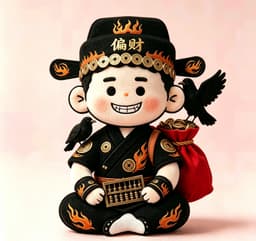
Piancai
“Where others see risk, you see opportunity.”
You see openings where others see walls. Opportunity doesn't find you by accident — you are tuned to the frequency of it, always half-listening for where the next door might be.
- An instinct for opportunity that borders on clairvoyance
- Resourcefulness — you always find a way through
- A generosity that draws people and luck toward you
- The same instinct that spots openings can't always tell a door from a trap
- Your attention scatters — you start more than you finish
- Flow is your nature, but some things only grow when held still
You love with charm and spontaneity, but you sometimes confuse the thrill of the new with the depth of the real. Your lesson is to learn the difference — and to let someone truly see the person behind the sparkle.
You're made for the spaces between — sales, negotiation, ventures, anything that rewards reading the room and moving fast. Structure bores you; stakes excite you. Just finish what you start.
Stories that sound like you.
You see openings where others see walls. It's not luck — you're tuned to a frequency most people miss. A conversation that turns into an opportunity, a chance meeting that becomes a partnership, a wrong turn that somehow lands you exactly where you needed to be. People call you lucky. They don't see the other half of it: you're always, always half-listening for the door. Opportunity finds you because you meet it halfway. You talk to strangers, you say yes to the unexpected, you follow the interesting thread even when it doesn't look like a plan. That openness is a skill, not a gift — and it's the reason you're never stuck for long. In the Ten Gods, this is Pian Cai (偏财) — the energy of opportunity, connection, and the unexpected windfall. It is the part of the chart that senses where the flow is moving and steps into it before anyone else notices. Your gift is that you're never trapped. Your shadow is that you can't always tell a door from a trap — and a door that opens both ways needs to be checked before you walk through. The reframe: trust your gut, but check the hinges. Your instinct for openings is real — honor it. But pair it with one cold, clear question before you commit: what's the cost if I'm wrong? You don't have to stop following the interesting thread. You just have to know which threads lead somewhere and which ones lead to a fall. Keep your door sense. It's rare and it's real. Just walk through with your eyes open, not just your heart. The people who master that balance get to keep all the luck — and survive the doors that were actually traps.
To you, money is energy — meant to flow, to be spent on the right people at the right moment, never hoarded in fear. When a friend needs help, you reach for your wallet before they finish asking. When a moment calls for celebration, you pick up the tab. You're generous in a way that makes people remember you, and you'd rather be remembered for that than for a fatter account. But generosity has a shadow, and you've felt it: the line between giving and leaking. There's a difference between money that moves because you chose it, and money that drains because you couldn't say no — to yourself, to a person, to the pull of wanting to be liked. In the Ten Gods, Pian Cai (偏财) is the energy of flowing wealth and abundant giving. It attracts and circulates money naturally, and it spreads it generously. That's a beautiful quality. But a river with no banks is just a flood, and a giver with no boundaries is just a spigot other people learn to turn on. The reframe: generosity isn't the same as leaking. The point is not to give less — it's to give on purpose. Learn which hands deserve it. The right ones multiply what you give; they turn your generosity into loyalty, opportunity, and a network that gives back. The wrong ones just take, and keep taking, and never once ask how you're doing. So keep flowing. That's who you are, and it's part of your charm and your power. Just build the banks. Give freely to the people who've proven they'd give back — and let the rest learn that your faucet isn't automatic anymore. Money in motion is a gift. Money with direction is a force.
Change doesn't scare you — it invites you. While others panic when the ground shifts, you're already finding your footing on the new terrain, mapping the exits, spotting the advantage in the disruption. You've been through enough upheaval to know you always land somewhere, and usually somewhere better than where you were. It's a superpower, and you know it. But it has a quiet cost: when you can survive anything, you start to believe you never have to stay for anything. You've started a hundred things — and finished fewer than you'd like to admit. You adapt so well that you never have to commit, and never committing is its own kind of trap. In the Ten Gods, Pian Cai (偏财) is the energy of flexibility and improvisation. It thrives on change, reads the moment, and pivots faster than anyone. But flexibility without commitment leaves you with a life full of beginnings and very few things that have been carried all the way through to real, lasting worth. The reframe: your adaptability is not the problem — your fear of finishing is. Starting is exciting; finishing is boring. But the people who actually build something lasting are the ones who learned to sit through the boring middle, the part after the novelty wears off, where the real value gets made. So pick one thing — the one that keeps pulling at you — and finish it, even when it stops being fun. Not because it's easy, but because it's how your sparkle becomes something that lasts. You'll never stop adapting. That's who you are. But adapt in service of something you stay with, and you'll go from a bright flash to a permanent light.
You collect people the way other people collect things. You remember names, birthdays, the small detail someone mentioned once that made their face light up. You can walk into a room of strangers and leave an hour later with three new connections and a real sense of possibility in the air. It's not calculated — it's just how you're wired. You genuinely like people, and they can feel it. But you've also noticed something: when you need something — advice, an introduction, a door opened — you almost always know someone who can help. And that, more than any paycheck, is the thing that has carried you through every turn in your life. In the Ten Gods, Pian Cai (偏财) is the energy of connection and network. Its wealth is not stored in an account — it's stored in relationships, in goodwill, in the thousand small threads of trust you've woven over the years. This is a real form of abundance, and it's one that only grows the more you water it. The reframe: your people are not a resource to be used — they're a garden to be tended. The reason your network works is that you've always given before asking, connected people before needing a connection, shown up without keeping score. Don't stop now that it's paying off. Keep giving first. Keep collecting, keep connecting, keep showing up. The relationships you build aren't a side benefit of your life — they are your life, and they are your wealth. In a world that's getting lonelier and more disconnected, the person who knows everyone and genuinely cares is becoming the rarest, most valuable thing there is.
You're the one who picks up the check, the one who lends the money without a second thought, the one who shows up with the gift or the favor or the open door. It feels good to be generous — it's part of who you are, part of how you show love. And for a while, it worked; your openness made people drawn to you. But lately you've noticed the balance has tipped. The people who once appreciated your generosity now expect it. They reach out when they need something and go quiet when they don't. The moment you hesitate, or say no, or gently suggest splitting the bill — you watch the warmth drain out of the room, and you realize they were never really friends with you. They were friends with your wallet. In the Ten Gods, Pian Cai (偏财) gives abundantly and freely — it is the most generous energy in the chart. But its shadow is exactly this: it can mistake being useful for being loved, and it keeps pouring into people who only value the pour. A gift that's expected is no longer a gift; it's a subscription, and you're the one paying it. The reframe: generosity that's taken for granted isn't generosity — it's a leak. The people who deserve your giving are the ones who'd still be there if you had nothing left to give. The test isn't how they act when you say yes; it's how they act when you finally say no. So say no once, and watch. The ones who stay are your people. The ones who drift were never worth the balance anyway. You don't have to stop being generous — it's one of the best things about you. You just have to stop spending it on people who treat your heart like an ATM.
You feel things quickly and deeply. You fall fast, you charm easily, you light up a room and every person in it. When you're interested in someone, you're fully present — attentive, generous, magnetic. It's not an act; it's real, in the moment. The problem is the moment doesn't always last, and people have noticed. So you've been called fickle, shallow, incapable of commitment. And it stings, because it's not true — not exactly. It's just that your heart is wide open, and a wide-open heart catches a lot of sparks. The challenge isn't that you can't love. It's that you love everything, and everything, to you, feels like it could be the thing. In the Ten Gods, Pian Cai (偏财) carries abundant feeling and charm — it is drawn to beauty, to connection, to the spark of something new. That magnetism is real and rare. But charm without discernment turns into a trail of half-finished loves, and eventually you start to wonder if any of it was ever real, or if you were just collecting moments. The reframe: the cure for fickleness isn't to feel less — it's to choose more deliberately. Your heart isn't the problem; your filter is. Before you pour yourself in, ask the question that charm never asks: is this real, or is it just new? New fades. Real holds. Keep your open heart. It's your gift. Just slow it down enough to tell the difference between a spark and a flame. The love you're looking for isn't the one that excites you the fastest — it's the one that stays interesting after the excitement wears off. Chase that one, and your "fickleness" will reveal itself as what it actually is: a heart still searching for its match.
You're drawn to the quick win. The trade, the deal, the opportunity that promises a fast return, the side bet that could pay off big. It's not greed, exactly — it's that you can see the upside instantly, feel the momentum, and the slow grind of saving a little every month has never once made your pulse quicken. You'd rather take a real shot than grind out a guaranteed little. And sometimes it works. That's the problem. Every time it works, it writes another line in the script: I've got the touch. But the script leaves out the times it didn't work — the losses, the near-misses, the nights you don't talk about. Fast money has a way of taking back everything it gave, plus interest. In the Ten Gods, Pian Cai (偏财) is the energy of windfall and speculation — it's wired to chase the quick return, the lucky break, the asymmetrical bet. This is a genuine strength when it's disciplined; it's how fortunes are made. But undisciplined, it's how they're lost, because the fast-money path plays exactly to your strengths and your blind spots at the same time. The reframe: the quick win isn't the enemy — the all-in is. The smartest players of the game you love don't bet everything on the fast money; they keep a slow, boring foundation underneath the exciting bets. That foundation is what lets them survive the losses and keep playing until the big one hits. So split your money the way you'd split a hand: most of it boring and safe, a little of it for the shot. Keep the thrill — it's part of what makes you good. Just never let the shot be the whole bankroll. You want to be the person who wins and keeps it, not the one who won big and lost it all twice.
You're the life of the room. People gravitate to you, laugh at your jokes, confide in you within an hour of meeting you. You make friends everywhere you go, and you're rarely, if ever, alone. On paper, you are the opposite of lonely — surrounded, sought after, always in demand. And yet there are nights, after the room has emptied, when a familiar hollow settles in. Because being liked by everyone is not the same as being known by anyone. You're so good at meeting people, at charming them, at reading what they need and becoming it, that you sometimes wonder if anyone has ever met the real you — or just the version of you that's easiest to love. In the Ten Gods, Pian Cai (偏财) radiates charm and connection — it is the most socially gifted energy in the chart. But that gift has a shadow: the performer can get stuck on stage, always reading the audience, never quite sure who they are when the lights go down. Charm can build a crowd and still leave you starving for one real person. The reframe: the cure for this loneliness isn't more people — it's more honesty. Pick one person, just one, and let them past the performance. Show them the tired version, the scared version, the one that doesn't have the perfect line ready. It will feel terrifying, and it will be the most real thing you've done in years. You don't have to give up your charm — it's your gift, and it opens doors nothing else can. But save a little of yourself for the ones who want the real thing, not the show. The room will always love you. What you're looking for is the one person who sees you when the room is gone.
Your life is a graveyard of beginnings. The business you launched with a burst of energy, the hobby you threw yourself into for six weeks, the language you were fluent in for a month, the project you were sure was "the one" until the next one came along. You're not lazy — far from it. You start things with more fire than most people ever muster. The problem is what happens after the fire. The grind, the repetition, the long boring middle where nothing exciting happens and progress is slow — that's where you slip away, pulled by the next bright idea, telling yourself you'll come back to the last one. But you rarely do. In the Ten Gods, Pian Cai (偏财) is the energy of novelty and opportunity — it loves beginnings, thrives on the fresh, and loses interest the moment something becomes routine. This is why you're so good at starting. It's also why your potential has stayed exactly that: potential, unspent, scattered across a hundred abandoned first chapters. The reframe: you don't need more ideas — you need more finish. One thing carried all the way through, past the boring middle, is worth more than twenty brilliant starts. Because finishing is where the actual reward lives: the skill, the confidence, the result you can finally point to and call yours. So choose one unfinished thing — the one that still tugs at you — and make a quiet promise: I'll finish this, even when it stops being fun. Not everything, just this one. Watch what it does to you. You've spent your life learning to start. Now learn the one skill you've been avoiding: staying. It's the difference between a spark and a life's work.
You've been through more changes than most people see in a lifetime, and every single time, you landed on your feet. Lost the job, found a better one. Ended the relationship, met someone new. The plan fell apart, and you improvised something better out of the wreckage. It's a gift, and you've come to rely on it — maybe too much. Because somewhere along the way, "I'll land on my feet" became a substitute for "I'll build something that lasts." You stopped worrying about the fall, because you know you can always recover. But recovering isn't the same as growing. You've been surviving beautifully for years, and quietly, you've stopped building anything you'd have to stay for. In the Ten Gods, Pian Cai (偏财) is the energy of resilience and improvisation — it survives anything, adapts to everything, and never stays down. That's a genuine superpower. But resilience without direction becomes a life of constant motion with no destination, always recovering, never quite arriving. The reframe: you don't have to choose between being resilient and being rooted. You can keep your ability to land on your feet and still plant something that takes years to grow. In fact, that's the only way your resilience turns into something meaningful instead of just... survival, forever. So start building one thing you can't walk away from easily. Something that would hurt to lose. Let it get roots. It'll feel strange, this staying — you're not used to it. But roots are what let a tree grow tall enough to matter. You've proven you can survive any fall. Now prove you can stay long enough to build something worth standing in.
“Understand your wealth DNA · Activate your business gift.”
Piancai is the part of you that spots the opportunity everyone else walks past. It is your natural nose for money, resources, and openings — the instinct that reads a situation and sees where the value is, before anyone else has even looked.
The Cognitive Awakening Course
“Know your energy. Awaken your life.”
You’ve met your archetype. Now learn to work with it — turn self-knowledge into a life you actually live.